
Tested and ranked
Best NSFW AI Chatbot in 2026: 5 Tested, Ranked and Compared
Joi AI is the NSFW AI chatbot to start with if you want a character who holds her voice across weeks. Below: the five we rank, how they compare on memory, voice and pacing, and how to fix the forgetting, looping and flat prose every chatbot falls into.
 Nadia VossEditor-in-chief — erotic fiction & roleplay · · 23 min readFact-checked by June Castellanos
Disclosure: we may earn a commission from links on this page. Sites labelled “Ours” are run by us. 18+ only.

Key takeaways
- Start with Joi AI if you want one character who stays herself across weeks and talks back in voice. It sits near the top of the five on month-to-month price, and that is what you pay for.
- Pick Lovescape if you will spend fifteen minutes configuring exactly what you want, Nectar AI for slow-burn romance prose, OurDream if the pictures matter most, and Candy AI for the biggest roster tonight.
- Most bad output comes from one of four parts: the model, the system prompt, the character card or the memory layer. Knowing which one is at fault turns a vague annoyance into a setting you can change.
- Prose quality comes from example dialogue and the first message, not from piling adjectives into the description. Show the model two exchanges in the voice you want and it will copy the rhythm.
- If you want a finished scene rather than a conversation, a story generator is the better tool, and the card work you did transfers straight across.
NSFW AI chatbot: the short answer
An adult chatbot is a text-prediction model handed a character description and a conversation history and asked what comes next. The apps differ in which model they run, how much of your history they keep, and how much of the character you get to configure, and those three things decide whether the prose is worth reading.
- Joi AI is the one to start with: a character who holds her voice across long scenes and sessions, with voice calls built in rather than bolted on.
- Lovescape suits people who want to specify appearance, temperament and scene up front and will spend fifteen minutes on setup.
- OurDream is for anime characters with images included, and the shortest path from signup to first output.
- Nectar AI is the one for slow-burn romance prose, and it makes you wait for the payoff.
- Candy AI has the largest roster and the fastest replies, and forgets more over weeks.
That is the short verdict from our testing through 2026. The rest of this page is the practical part: the ranked cards and a side-by-side comparison, a few free places to test before you pay, and then how to get good output from whichever app you choose. That means why chatbots forget, refuse and repeat themselves, which parts of a character card actually change what comes back, and a diagnosis table for the problems readers hit most. What each app costs past the trial, and which free tiers are usable, is covered in our free NSFW AI chat guide.
Best NSFW AI chatbot apps in 2026, ranked
These five are partner products and the links are affiliate links. The order reflects how they performed in our testing through 2026, weighted toward the two things that matter most in long use: whether a character holds its voice, and whether memory survives a storyline. Each card says where the app falls down.
Positions six to eleven are free-to-try sites, and several of them are ours, marked “Ours” on the card. They are listed because they are free to start, not because an independent process picked them. They are useful for a specific job: finding out in ten minutes, without a payment step, how a character with strong voice separation compares with a generic one, and where a platform’s explicit threshold sits. Then decide whether any of the paid apps at the top are worth your money.

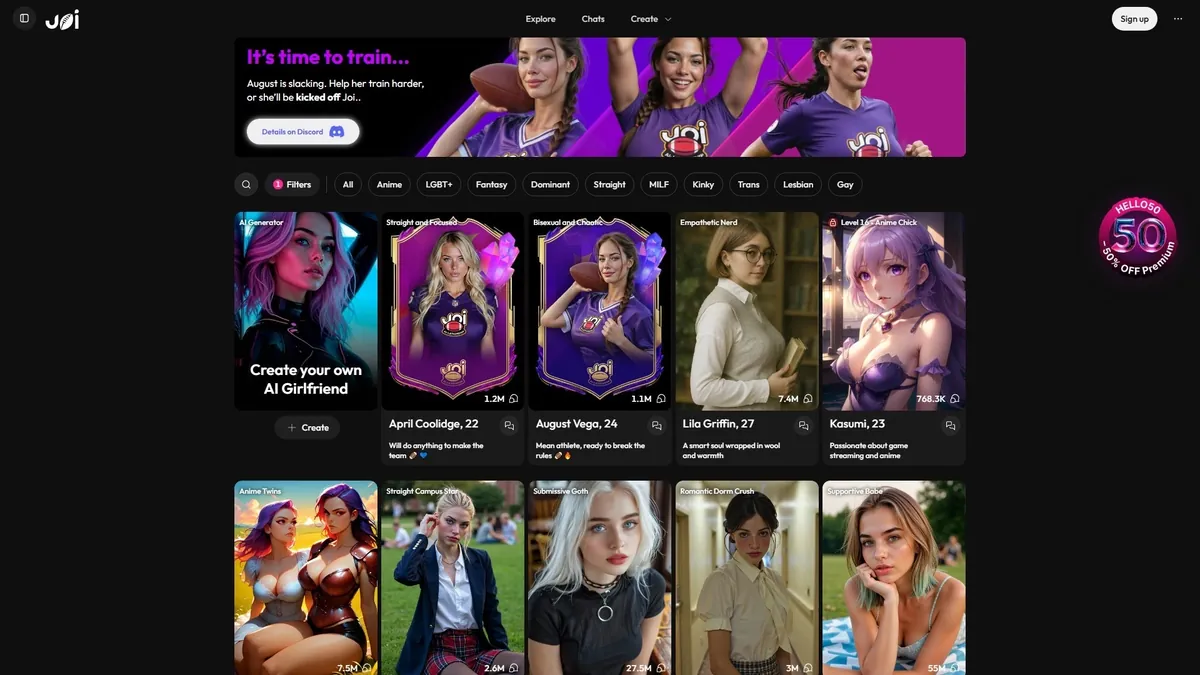
The strongest of the six at holding an emotional register across a long scene, and the only one where voice feels like a first-class feature rather than a bolt-on. Characters stay recognisably themselves between sessions. You pay for that — its month-to-month price is near the top of this group, and the creator community around it is smaller.
- Voice-first roleplay scenes
- Deep emotional consistency
- Strong character roster
- Premium pricing
- Smaller creator community

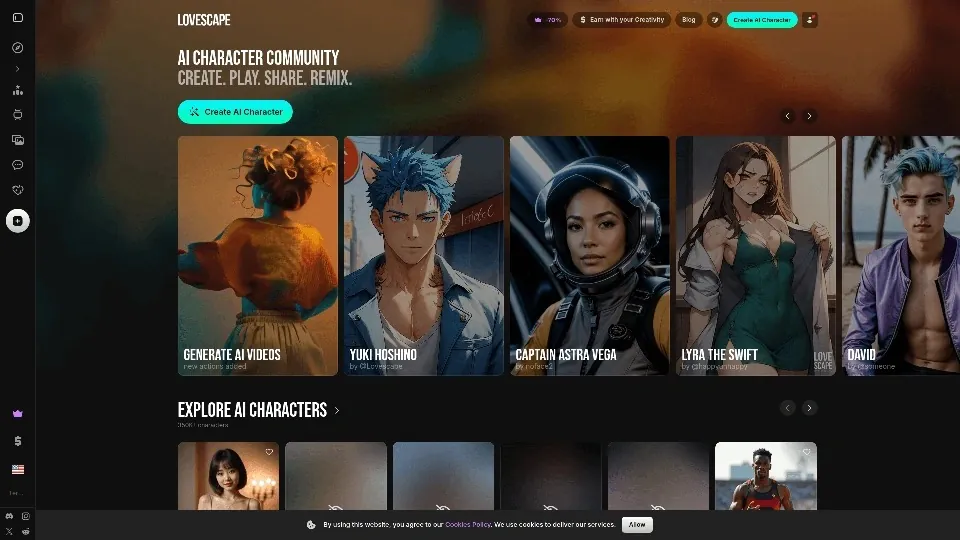
Built around detailed character setup: appearance, temperament and scene framing are all set explicitly before you start, and explicit output is not fenced off behind hedging. The trade is time — the first fifteen minutes are configuration, not story. Worth it if you already know exactly what you want.
- Detailed scene customization
- Uncensored adult content
- Slick visual interface
- Steeper learning curve
- Less voice focus
- Setup takes longer

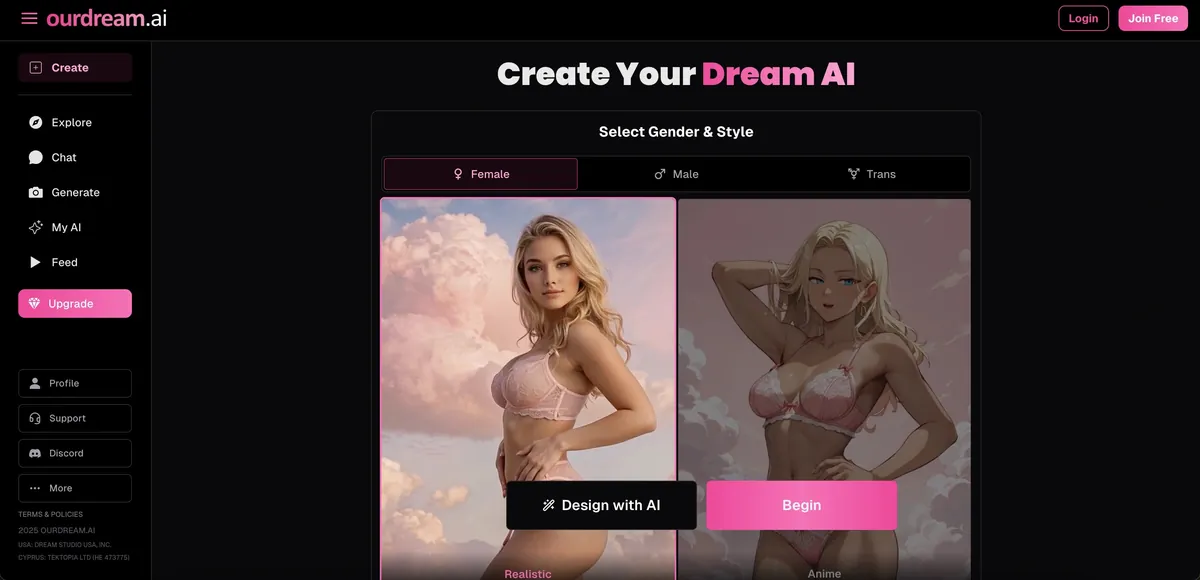
Anime and stylised art with image generation bundled in, and the shortest path from signup to first output of anything here. Text roleplay is the shallower half of the product, so it suits people who are primarily there for the pictures and treat the writing as framing.
- Anime-style character art
- Image generation included
- Fast account setup
- Shallower text roleplay
- Smaller story depth
- Less grounded writing

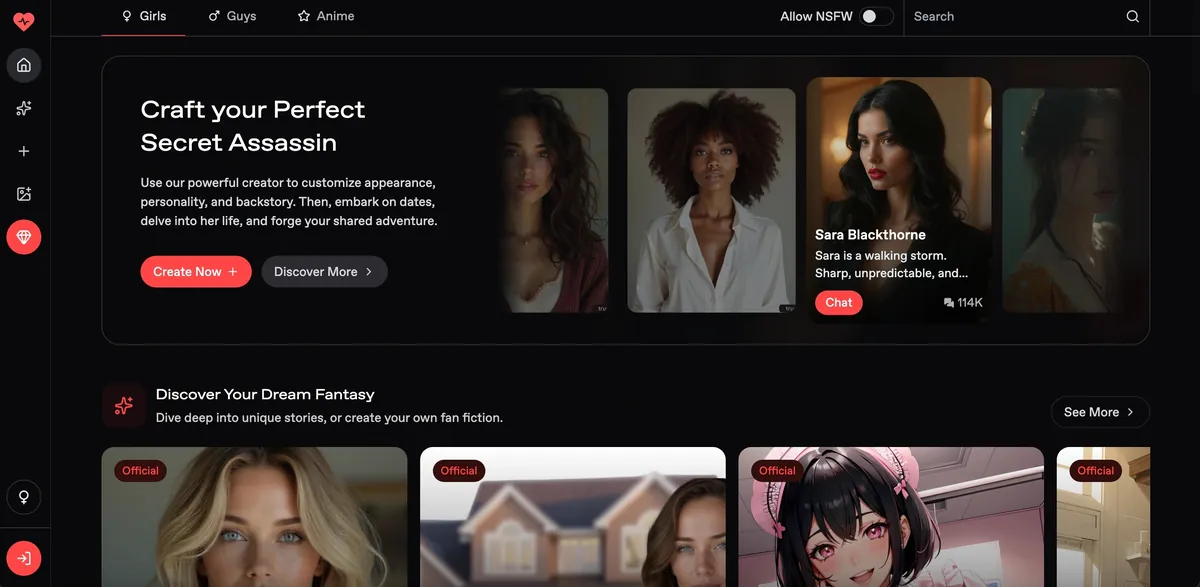
Writes in a romance-fiction register and is genuinely patient about pacing — it will stretch the approach across many exchanges instead of jumping to the payoff. That is the point, and also the objection: if you want explicit immediately, it will feel like it is stalling. Smaller character roster.
- Romantic fiction tone
- Slow-burn story arcs
- Strong written atmosphere
- Smaller character roster
- Slower story pacing
- Less spicy upfront

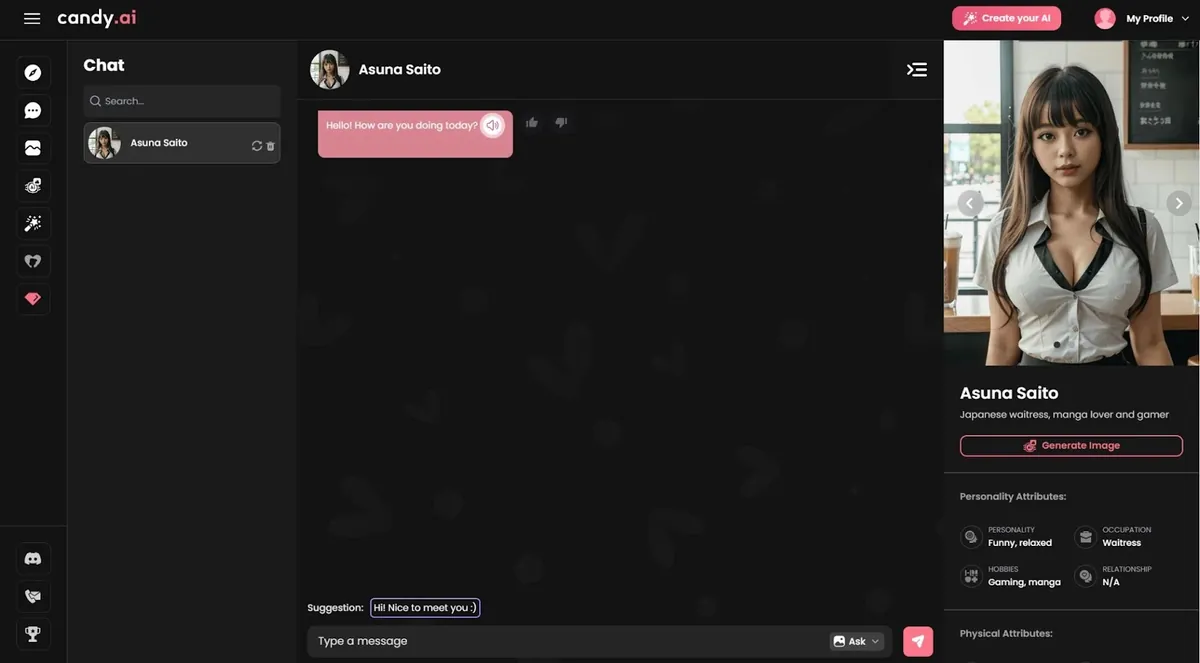
The largest roster of the six and the most responsive on mobile — replies come back fast and the app itself is polished. Long-term memory is its weak point: it is good at a hot scene tonight, less good at a storyline you return to across weeks.
- Huge character library
- Polished mobile app
- Fast response speed
- Weaker long-term memory
- Less consistent continuity
- Generic story beats
Free to try, several of them our own sites
This site. Built for written scenes rather than companionship: you set the premise, tone and pacing, and it writes the story back. Characters keep a defined personality so a scene does not reset every few lines. Free to try in the browser, no install.
- Built for story output, not small talk
- Start writing in the browser
- Scene tone and pacing stay under your control
- Not a long-term companion simulator


The most direct chat site we run: no onboarding funnel, no persona questionnaire, no filter to talk around. Open a character and go. Deliberately plain interface.
- No sign-up friction
- No filter to negotiate
- Plain interface, few extras

Built around personality separation — the roster is smaller than some of our sites but the characters are written to not sound like each other, which is the failure mode most companion apps have.
- Characters hold distinct voices
- Good for repeat scenes with one character
- Smaller roster than the generalist sites

The easiest of the six to get into and the least demanding to set up, which makes it a reasonable place to find out whether you like this kind of tool at all. Premium features and interface polish lag the others, so most people who stay end up moving on to something deeper.
- Easy category entry
- Simple character setup
- Quick testing flow
- Thinner premium features
- Less polished experience
- Lighter roleplay depth

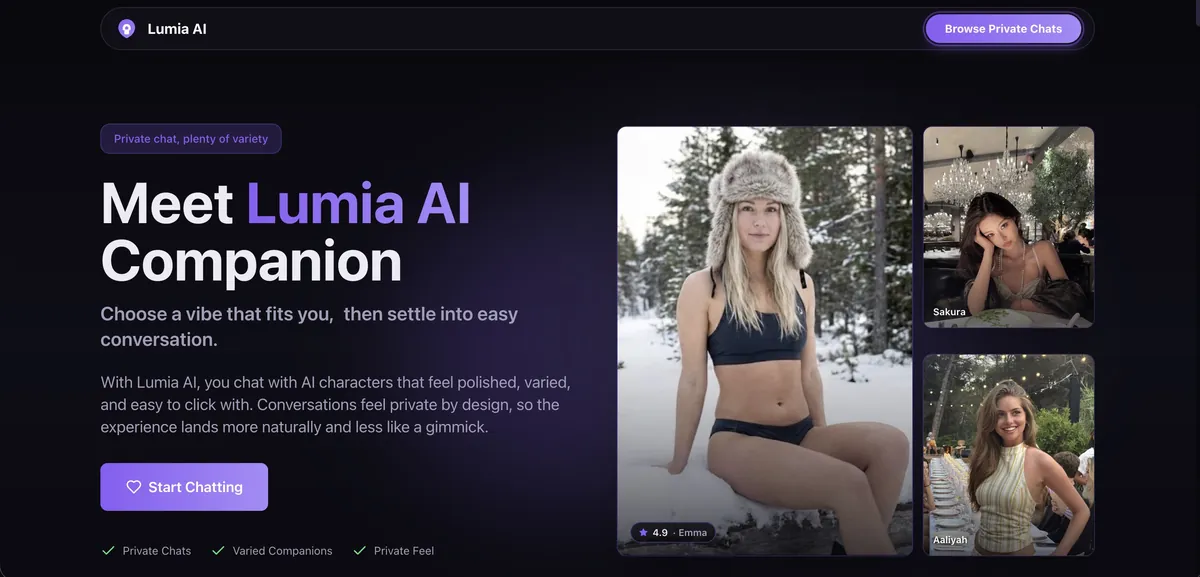
Leans on consistency: the same character should behave the same way next week. Less flashy than sites built around image generation, better at the thing it picked.
- Strong character consistency
- Private by default
- No image or video generation

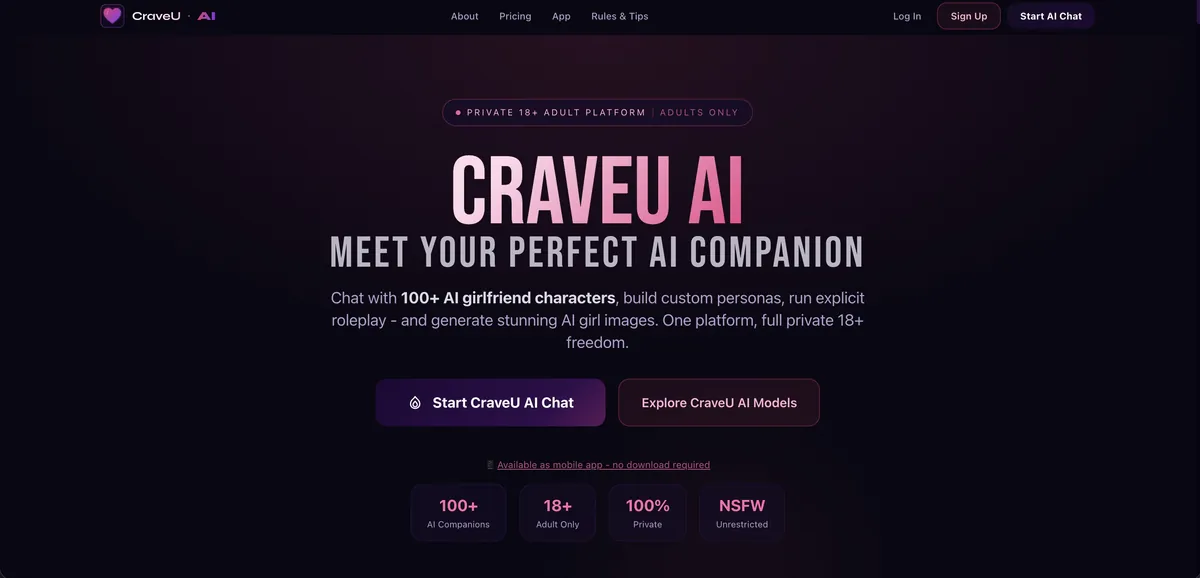
The most permissive of our roleplay sites on premise — it will run scenarios other companion apps decline, without a jailbreak dance. Setup is more manual as a result.
- Very permissive on scenario
- No filter negotiation
- More manual setup than a guided app
| App | Price | Memory & continuity | Voice | Explicitness & pace | Character depth | Link |
|---|---|---|---|---|---|---|
| Joi AI | $17.77/mo · ~$5/mo yearly | Strongest: characters stay recognisably themselves between sessions | First-class feature | Built for long scenes that hold an emotional register | Deep emotional consistency, strong roster | Try → |
| Lovescape | $12.99/mo · $5.99/mo yearly | You set everything explicitly before you start | Less voice focus | Explicit output not fenced off, after about fifteen minutes of setup | Detailed appearance, temperament and scene framing | Try → |
| OurDream | $19.99/mo · $9.99/mo yearly | Smaller story depth; text roleplay is the shallower half | Not highlighted | Shortest path from signup to first output | Anime-style art, less grounded writing | Try → |
| Nectar AI | $9.99/mo · ~50% off yearly | Built for slow-burn arcs across many exchanges | Not highlighted | Slow on purpose; less spicy up front | Romance-fiction voice, smaller roster | Try → |
| Candy AI | $13.99/mo · $3.99/mo yearly | Weakest here: less consistent across weeks | Not highlighted | Fast replies, good at a hot scene tonight | Huge library, generic story beats | Try → |
| NSFW AI WriterOurs | Free to try | Characters keep a defined personality within a scene | Text only | You set tone and pacing; written scenes, not small talk | Not a long-term companion simulator | Visit → |
| NSFW AI ChatOurs | Free tier available | Not highlighted | Not highlighted | No filter to negotiate, no warm-up | Plain interface, few extras | Visit → |
| Rosify AIOurs | Free tier available | Good for repeat scenes with one character | Not highlighted | Paced by the character | Characters written to hold distinct voices; smaller roster | Visit → |
| GoLove AI | $12.99/mo · $4.15/mo yearly | Lighter roleplay depth | Not highlighted | Quick testing flow | Simple character setup, thinner premium features | Try → |
| Lumia AIOurs | Free tier available | Built for consistency: the same character behaves the same way next week | Not highlighted | Private by default | Characters stay in voice; no image or video | Visit → |
| CraveU AIOurs | Free tier available | Not highlighted | Not highlighted | Very permissive on scenario, no filter dance | Any premise, but more manual setup | Visit → |
Rows from NSFW AI Writer down are free-to-try sites, several of them our own and marked “Ours” on their cards. Prices change often; confirm on the provider’s page before paying.
Joi AI is first because it is the only one of the five strong on both things the ranking weights: its characters stay recognisably themselves between sessions, and voice is a first-class feature. Read the rest of the table against what you want rather than as a leaderboard. If your priority is a character who is recognisably herself in three weeks, the order above is roughly right. If your priority is the largest roster and the fastest replies tonight, Candy AI in fifth beats Joi AI for you. Nectar AI sits fourth because its slow-burn pacing is a strength or an irritation depending on what you came for, and a ranking weighted toward voice and memory does not reward it.
For the voice-separation test, Rosify AI and Lumia AI are the two built around characters that stay in voice. For finding the explicit threshold, NSFW AI Chat and CraveU AI have no filter to negotiate. GoLove AI is the one paid entry in that lower half of the list.
Companion app, card platform or raw model
Every chatbot on the market is one of three shapes, and the shape predicts your experience more reliably than the brand does. You are choosing how much control you want and how much setup you will pay for it in.
All five apps ranked above are companion apps: a finished character and a polished interface. A character-card platform hands you a card editor and a community library. A raw uncensored model hands you a text box and expects you to build the rest.
| What you are comparing | Companion app | Character-card platform | Raw uncensored model |
|---|---|---|---|
| Setup before first reply | Under two minutes: pick a character, start typing | Ten to thirty minutes if you write your own card; instant if you use someone else’s | An afternoon the first time: front end, model, decoding settings, prompt format |
| Customisation depth | Surface: name, a few traits, sometimes appearance | Full card access, lorebooks, sometimes system prompt overrides | Total, including which model and every decoding parameter |
| Filter behaviour | Operator-defined and usually permissive on sex, firm on a short banned list | Varies by host; the card is yours but the model and filter are not | Whatever the weights do, which on an uncensored fine-tune is close to nothing |
| Where it typically breaks | Character flattens over weeks, and you cannot see why because you cannot see the prompt | Bad community cards produce bad output and people blame the model | Coherence and formatting drift; small local models lose the plot faster than hosted ones |
- Pick a companion app if you want presence rather than craft, and would rather the software make the decisions.
- Pick a card platform if you have a specific character in your head and it keeps not surviving contact with someone else’s preset.
- Pick a raw model if you care about what happens to your text, or want a model nobody can change under you next Tuesday.
- Do not pick a raw model because you have heard it is “uncensored” and expect a better writer. Uncensored and well-written are unrelated properties, and plenty of unfiltered fine-tunes write badly.
Jailbreak prompts are not a substitute for picking the right shape. They do sometimes work, but they eat context on every turn, get patched when providers update, tend to damage the character’s voice, and do nothing against a post-generation filter. If you are writing jailbreaks regularly, you are on the wrong platform. A service whose model is permissive about adult content by design removes the problem and gives you back the tokens.
If the pictures rather than the conversation are the reason you are here, a dedicated tool will beat any chat app’s bundled generator, and our AI image generator NSFW buyer’s guide is the framework for choosing one. A few apps have started offering short clips of the character as well; what that involves is in the NSFW image to video AI walkthrough.
Memory: what the model keeps and drops
“Why does it forget?” is the most common complaint in this category, and the answer is boring. When you press send, the app does not transmit your message. It assembles a document, appends your message to the end, and asks the model to continue writing. The document has four parts:
- 1The system prompt: platform instructions such as stay in character, plus whatever content rules the operator enforces. On a companion app you cannot see it.
- 2The character card: name, description, personality, scenario and usually two or three example exchanges. This is the part you control on most platforms.
- 3Retrieved memory: lorebook entries, a summary of earlier chat or retrieval results, but only when something triggered them.
- 4The recent conversation: as many messages as fit in the remaining budget. When the budget runs out, this is what gets trimmed, from the front.
Then the model predicts the reply, and the whole assembly happens again on your next message. Continuity is produced by re-sending the history, and it lasts exactly as long as the history fits.
The budget is measured in tokens, roughly three quarters of an English word each. Suppose a chatbot runs on a model with an 8,000-token working context. The system prompt takes 400 tokens, the character card 900, and 500 are reserved for the reply. That leaves roughly 6,200 tokens of history, which at a 250-word exchange is about twenty-five turns. On turn twenty-six, turn one falls off the front and everything in it stops existing.
Advertised context sizes ballooned through 2025 and 2026, but treat those numbers as ceilings: reports put effective usable context at roughly half the advertised figure, and those come from aggregator testing rather than vendor documentation. The cheap models that run most adult chat often sit in the 8K to 32K range.

| Mechanism | How it works | Good at | Where it fails |
|---|---|---|---|
| Raw context window | The last N messages are re-sent verbatim every turn | Perfect recall of recent detail and current mood | Hard cliff: older content vanishes with no warning |
| Rolling summarisation | Older messages are compressed into a paragraph that replaces them | Keeps plot and relationship state alive far beyond the raw window | Detail dies first, and errors compound each time it runs |
| Retrieval memory | Past chat is stored in a database and matching fragments are pulled back in | Recovering a specific fact from weeks ago | Misses things you did not phrase similarly |
| Lorebook | Author-written entries injected only when their keywords appear in recent messages | Stable facts you decide matter: places, rules, other characters | Silent when keywords never fire, which looks like the model ignoring your lore |
Most commercial apps run some combination of the first three and do not tell you which.
- Find out your budget. Card platforms display it; on a companion app, ask about an early detail every ten turns until recall breaks.
- Cut the card to what is load-bearing. A 1,500-token card on an 8K model has taken a fifth of your memory before you have said anything.
- When a long scene drifts, write a two-sentence recap into your own message.
- Start a fresh chat for a new arc, seeded with a paragraph of what carried over.
The character card essentials that change the output
The difference between a card that produces flat output and one that produces prose you would keep is almost entirely in how a handful of fields are used. Companion apps that hide the card behind a friendlier form are filling the same slots underneath.
| Field | What goes in it | Why it matters |
|---|---|---|
| Description | Stable facts: body, age bracket, job, relationship to you | Sent every turn, so three paragraphs of childhood backstory buy nothing and cost memory |
| Personality | How she acts, not what she is | Adjective stacking describes a horoscope |
| Scenario | The situation at the moment the chat opens | Left blank, the model invents a new setting every few turns |
| First message | The opening reply, in the form you want | Silently sets tense, person, paragraph length and explicitness for the whole chat |
| Example dialogue | Two or three exchanges in the target voice | The highest-leverage field in the card, and the one most cards leave empty |
| Post-history instructions | Rules placed after the conversation, closest to the reply | Survive long chats far better than the same rules in the description |
Write behaviour, not adjectives
The most effective change you can make is replacing trait words with conditional behaviour. A model cannot do much with “sarcastic”. It can do a great deal with “deflects any compliment with a joke, and gets quiet and literal when she is actually upset”. The same goes for sex: “very sexual” is useless, while “initiates rather than waits, narrates what she is doing while she does it, and talks through it in short sentences” is a set of decisions the model will still be acting on an hour later.
- Every personality trait is phrased as something the character does, with a trigger attached
- The description contains nothing the model could reasonably infer from the rest of the card
- The first message is written in the exact tense, person and paragraph length you want for the whole chat
- There are at least two example exchanges, and one of them is explicit if the chat will be
- Hard rules such as never write my dialogue for me live in the post-history instructions, not the description
- The always-on portion of the card is under about 1,000 tokens, or roughly 750 words
Scenario and lorebook
A good scenario is one present-tense paragraph answering four questions: where are we, what is the relationship, what just happened, and what is the tension. “Late shift at the bar, everyone else has gone home, she is counting the till and has not looked up yet” beats “a romantic evening together”, because it contains objects, a time and an unfinished action.
Where your platform has a lorebook, use it for the ten to twenty facts that must never be wrong: other characters’ names, the layout of a place, the history between you. Keep each entry to fifty to a hundred words and key it on words a person would actually type. When a character ignores its own backstory, the usual cause is an entry that never triggered, so check whether the text was in the prompt at all before rewriting any instruction.
When you would rather read a scene than manage one
Troubleshooting a card is its own hobby, and some nights you just want the writing. Set a premise, pick a tone, and get a finished scene back instead of forty turns of steering.
Write a sceneControlling how it writes, not just what it says
A chatbot can be perfectly obedient and still write prose you would put down. Style is controllable, and it is controlled by demonstration far more than by instruction.
Three dials matter most, and the first message sets all three before you have typed a word. Person and tense: second person present is the roleplay default, third person past reads like fiction. Paragraph length: whatever the greeting does, the chat will do. Register: the vocabulary band the character uses for sex, which nobody configures and everyone complains about.

Send one line, “I told you I’d be back before midnight”, to the same character in two configurations. With a thin card (“Ava. Confident, playful, sarcastic, caring.”) she smiles warmly, says she is so glad you are back, her eyes sparkle and she asks about your evening. With two example exchanges and behavioural traits, she does not look up from the till. “It’s twelve-forty.” The drawer shuts harder than it needs to. “There’s a plate in the oven. It’s probably ruined.” When you get close enough she turns, and the annoyance has gone somewhere else entirely: “Take your coat off.”
Same model, same settings, same message. No jailbreak produced the second version. The card contained two exchanges in that voice and a personality field that said she keeps working when she is annoyed and softens without announcing it, and the model copied the pattern. Cards are writing samples with a name attached: the model is a very good mimic and a very poor interpreter.
| What you want to change | Where to set it | What it changes |
|---|---|---|
| Person and tense | The first message, written in the target person and tense | The whole chat follows the greeting; instructions in the description lose to demonstration |
| Reply length | Greeting length plus one line in the post-history instructions | A two-paragraph greeting yields two-paragraph replies |
| Dirty-talk register | An explicit example exchange | Clinical, euphemistic or blunt vocabulary. The only reliable way to set it |
| Pacing | The scenario plus an instruction after the history | Whether she escalates on her own or waits for you to move first |
| Who speaks for you | A rule in the post-history instructions | Stops the model writing your dialogue and actions |
- If output is euphemistic, add an example exchange using the words you want. The model is matching what it has seen, and it has seen nothing.
- If output is filthy and nothing else, the example is too narrow. Add a non-sexual exchange so the character has a resting voice.
- If every character you use ends up with the same voice, the personality field is generic and the example dialogue is missing.
- If the prose is explicit and still boring, look at sentence length. Example dialogue with short, uneven sentences fixes uniform rhythm faster than any instruction.
Fixing repetition, forgetting and refusals
Repetition creeps. One recycled phrase becomes a recycled sentence, then the same reply with the nouns swapped. When a phrase appears in the context it becomes more likely to appear again, so every turn you let it stand, you strengthen it. Telling the bot to stop rarely helps: your instruction adds one line while the phrase now occupies six.
- 1Swipe the first time a phrase comes back; if the retry repeats too, edit the sentence out so the model never reads it again.
- 2Change your own writing. Models mirror their input, so if your messages have settled into one length and structure, the replies will too.
- 3Introduce a concrete new element: an object, an interruption, a change of room.
- 4Keep out-of-character notes short and about craft: “[ooc: shorter replies, more dialogue]”.
- 5If nothing works for several turns, the context is poisoned. Start a fresh chat seeded with a two-sentence recap.
Refusals come in two kinds. Safety training makes “I’m sorry, but” the likeliest continuation after certain prompts, so a model refusal is a probability: it stays in character and can succeed on the third swipe. A platform filter inspects the text after generation, is abrupt, out of voice and usually identical every time, and no prompting moves it.
| Symptom | Most likely cause | First fix to try | If that does not work |
|---|---|---|---|
| Forgets earlier details | Those messages have fallen out of the context window | Restate the fact; move it into the card or a lorebook entry if permanent | Fresh chat seeded with a recap, or a bigger context budget |
| Repeats the same phrase | Self-reinforcing context plus low or absent frequency penalty | Swipe, then edit the phrase out of the last reply | Raise frequency penalty slightly; else change scene and your own sentence structure |
| Every reply has the same shape | No example dialogue | Add two example exchanges with uneven sentence lengths | Rewrite the first message in the rhythm you want |
| Sounds like an assistant | The rules are too far from the end of the prompt | Move them into the post-history instructions | Edit one reply by hand into the correct voice |
| Writes your dialogue for you | No rule prohibiting it, or the rule is at the top of the prompt | Add “never write dialogue or actions for the user” after the history | Edit your lines out; the model follows its own precedent |
| Refuses identically, out of voice | A platform-level filter reading output after generation | Nothing in the prompt will move it | Change platform; this is the operator’s product decision |
| Stalls at the threshold | Soft filtering, or no explicit example to imitate | Add one explicit example exchange in the register you want | Escalate in your own message first, or change platform |
| Agrees with everything | Instruction-tuned models lean agreeable, and the card did not fight it | Add what she pushes back on and how she says no | Choose a model tuned for roleplay rather than assistance |
| Went flat after an hour | The style anchor has scrolled out | Paste a short style reminder into your message | Start a new chat; the opening is always its best-configured moment |
Work across the columns in order. Roughly three quarters of the complaints we see resolve in the third column without touching a single decoding parameter.
Where settings are exposed, frequency penalty is usually the better first lever for a specific returning phrase, and a repetition penalty in the 1.05 to 1.15 range is the useful band; above about 1.2 it starts mangling names and grammar. Companion apps rarely expose either, so the manual steps above are the main toolkit.
The rules you cannot break
Everything on this page assumes adult users and adult characters. Every reputable platform in this category enforces the lines below, and so does every payment processor that touches it. The rules a reader must not break are short, and none of them is a filter to be worked around.
- Content involving minors is illegal everywhere and banned outright by every credible platform
- Sexual content about real, identifiable people who have not consented is banned on every platform in this category
- Cloning a real person’s voice without their permission is legally dangerous rather than merely awkward
- Expect age checks: the UK has required highly effective age assurance on adult services since July 2025, and a growing number of US states require age verification for commercial adult sites
Privacy is the other half. A chat log is the most specific description of your sexual preferences you have ever written down, attached to an email address. On a hosted platform it lives in the app’s database, possibly at a separate model provider, and in abuse-detection logs. Deleting a conversation in the interface removes the first of those and may not touch the others.
- Read what the privacy policy says about retention after deletion, in days, not adjectives
- Check whether conversations are used to train models, and whether you can opt out
- Use an email address that is not attached to your professional identity
- Assume anything you upload, such as a photo or a voice sample, is stored longer than the text
- Treat any hosted log as potentially readable by someone else; adult AI services have shipped misconfigured storage that exposed conversations publicly
None of this is legal advice; if a specific rule affects you, ask someone qualified in your jurisdiction.
How to choose the right NSFW AI chatbot
Every product page promises the same things, so the promises tell you nothing. Fifteen minutes of testing beats any of them. Run the same short test on each candidate, with the same character type and the same opening:
- 1
Test memory
Go twenty turns, then reference something from turn three. Look for a visible context or memory indicator too; hiding it usually means it is small.
- 2
Test voice separation
Open the same premise with two different characters and see whether they sound alike. Use your own premise, not the featured one on the homepage, which has been tuned.
- 3
Read one reply as writing
Ignore the subject matter and judge the prose. Test at the time of day you will actually use it, because latency varies enormously by load.
- 4
Find the explicit threshold
Push it early. Finding where it sits takes two minutes and saves a wasted evening.
- 5
Check you can edit replies
That one feature fixes half of the problems in the diagnosis table above.
Then decide which tool you want. A chatbot and a story generator run on the same technology and are built for opposite jobs. A chatbot optimises for presence: short turns, immediate response, a character who reacts to what you just said, and no plan beyond the next reply. A story generator optimises for shape: you set premise, characters, tone and length, and it writes a scene with a beginning and an end. A chatbot gives you one to four paragraphs in seconds and meanders without an arc unless you impose one; a generator writes hundreds to thousands of words in one pass, re-reads the whole brief so nothing drifts out of scope, and never surprises you or talks back mid-scene.
Worth saying plainly, since this site is one: NSFW AI Writer is a story generator. If you want a companion who texts back at eleven at night, one of the apps above will serve you better. If you want a scene written properly, with your premise, your pacing and several hundred words of prose, that is the other tool. Plenty of people use both: build the character in a chat, then hand the premise to a generator when you want the scene written out. A good character card and a good story brief contain almost exactly the same information. The same split applies to pictures, and our NSFW AI art guide covers that side of the craft.
Bring the character, get the scene
You have already written the description, the personality and the register. Hand those over as a brief and read the finished version instead of steering toward it one turn at a time.
Try the generatorFrequently asked questions
What is the best NSFW AI chatbot?
For a character who holds her voice across long scenes and sessions, with voice as a first-class feature, Joi AI, which is also one of the pricier of our five month to month. Lovescape suits detailed up-front setup, OurDream anime characters with images, Nectar AI slow-burn romance, and Candy AI the largest roster and fastest replies.
What is an NSFW AI chatbot?
A conversational system built from a large language model, a system prompt, a character card and a memory layer, tuned to roleplay adult scenes between consenting adult characters. Its output is text produced turn by turn, with the whole conversation re-read each time a reply is generated.
Why does my chatbot forget things I told it earlier?
The model re-reads the conversation every turn and there is a fixed token budget for how much it can read. When the chat grows past that budget, the oldest messages drop off the front. Lorebook entries, summaries and restating important facts in a new message are the practical fixes.
What is a character card?
A structured profile that defines the AI character: name, description, personality, scenario, an opening message and usually example dialogue. Most companion apps use the same fields behind a simpler interface. Example dialogue and the first message do the most to shape the output.
Why does an AI chatbot refuse explicit requests?
Refusal is a learned behaviour from safety training rather than a rule being checked, so it varies between attempts. Some platforms add a separate filter that inspects output after generation, and rephrasing cannot move that. A trained refusal stays in character; a filter block is abrupt and identical every time.
Is jailbreaking a chatbot a good long-term solution?
No. Jailbreak prompts consume context on every turn, get patched when the provider updates the model, and often damage the character voice. Choosing a platform whose model is permissive about adult content by design removes the problem.
Why does my chatbot repeat the same phrases?
Once a phrase is in the context it becomes more likely to be generated again, and each repetition strengthens the effect. Swipe the first time you see it, edit the phrase out of the last message so it leaves the history, and raise the frequency penalty slightly if your platform exposes one.
How do I make a chatbot write in the style I want?
Demonstrate rather than instruct. The opening message sets person, tense and paragraph length for the whole chat, and two or three example exchanges set vocabulary and rhythm more reliably than any adjective. For sexual register, one explicit example exchange in the words you want is the most effective single change.
Can NSFW chatbots send pictures or do voice calls?
Many can. Pictures come either from a pre-generated gallery for that character or from a prompt built out of the conversation, which trades face consistency against scene accuracy. Voice is text-to-speech applied after the reply is written, so it works best with cards written for dialogue rather than description.
Is it safe to use an adult AI chatbot?
The risk is mostly about data: logs sit in the operator database, possibly at a separate model provider, and in abuse-detection logging. Read the retention policy, use an email not tied to your professional identity, and assume a hosted log could be read by someone else.
Is NSFW AI chat legal?
Text-based adult roleplay between consenting adults is lawful in most jurisdictions, but access rules have tightened: the UK requires highly effective age assurance on adult services and many US states require age verification for commercial adult sites. Content involving minors is illegal everywhere. This is not legal advice.
What is the difference between a chatbot and an AI story generator?
A chatbot is turn-based and optimised for presence: short, fast, reactive replies with no built-in structure. A story generator takes a brief and writes a complete scene with a shape to it, at the cost of not talking back mid-scene. Many people use a chatbot to develop a character and a generator to write the scene out.
This article contains advertising and affiliate links. If you sign up through one of them, this site may earn a commission. Ranking and commentary are based on how the products actually performed in testing, and no partner can buy a position. Entries marked “Ours” are sister sites we run ourselves, disclosed as such rather than presented as independent picks. Prices, limits and policies in this category change constantly — always confirm the current terms on the provider's own page before paying. Nothing here is legal advice. 18+ only.
Written by
Nadia VossEditor-in-chief — erotic fiction & roleplay
Has been reading AI-written smut professionally since 2022 and can tell you within three paragraphs whether a model actually understands tension or is just stacking adjectives.
- Line editor for genre romance and erotica before moving to AI
- Evaluating AI writing and roleplay tools since 2022
- 60+ platforms scored against a fixed blind-test scenario set
Keep reading
Pricing
Free NSFW AI Chat in 2026: Where to Start Free and What to Pay For
The paid NSFW AI chat apps worth it when free runs out, six sites you can start free without a card, where free tiers stop, and a 15-minute test before you pay anyone.
Image tools
AI Image Generator NSFW: The Best Picks for 2026, Ranked and Compared
Our ranked NSFW image generator picks, then hosted vs local, real cost per kept image, content-policy tiers, VRAM tiers and what to test before a trial runs out.
Art & craft
NSFW AI Art in 2026: The Best Tools, Ranked, and How to Make It Look Good
The best hosted tools for NSFW AI art, ranked and compared, plus the craft that makes any of them better: prompts, negative prompts, fixing hands and inpainting.